My reading list so far this year has been pretty heavy on community development and civic leadership topics. And it’s got me thinking.
In the same way that those of us in the business advising space think of a business like an ecosystem, a collection of loosely coupled entities that all work together to create a healthy and vibrant “whole”, so too is a community.
Recently, I’ve been reading (listening to) Strong Towns by Charles Marohn. Mr. Marhron, is a land use planner and municipal engineer turned author and dense town restructuring advocate.
Mr. Marohn argues that our decades-long experiment of building communities around continuous growth (and the automobile) has failed. It has left our communities hollowed out and reliant on ever-increasing levels of debt to manage miles and miles of crumbling infrastructure.
He doesn’t have any easy answers for this dilemma, unfortunately, but he does help us understand that, like businesses, communities are complex systems, systems that are unpredictable, messy, and volatile. Accordingly, like our businesses, we need to approach their growth and resilience with an eye toward stability, consideration for the way that the individual parts interact with one another, small experiments, and sustainable and incremental growth.
His argument is fairly compelling, especially for those of us who grew up in the rust belt where we’ve experienced first hand what happens when a community grows with little regard for the future and then watches as the traditional stewards of that growth, big business, leave for cheaper pastures.
Perhaps it’s not surprising that our businesses have had a laser-like focus on extractive and rapid growth for decades now. This model has continued to fill their leaders’, owners’, and stakeholders’ coffers. And our communities have been supporting this model through policies, incentives, and planning models that actually encourage such behavior.
Maybe it’s time our local business leaders and our local government representatives work together to build something better, though. One that thinks about growth in a more resilient, holistic, and systemic way. One where the goal isn’t to extract as much value as possible from the community and it’s members, leaving them empty and devoid of value, but instead where the goal is to build “scaffolding” for the businesses that actually want to invest for the long haul, in a steady and incremental fashion, leaving a rich, vibrant, and thriving community in their wake.
Mr. Marohn points out that a shift toward this way of managing our communities (and by default our local businesses) will require communities to take ownership of their own destiny, to minimize their reliance on the fast money that comes from state and federal support and policies that encourage short term growth, and instead focuses on growing local tax bases and income models and, along the way, de-emphasizes growth for growth’s sake.
Marohn thinks such an approach would naturally result in a sort of shrinking of our communities back to a more dense, city-centered landscape and way of life.
I suppose he is probably right. And admittedly, this situation does present some pretty significant problems for the millions of us who live in the suburbs. One that we need to think about addressing in thoughtful ways.
But what is especially interesting to me, as a self-described strategic business advisor and community changemaker, is the opportunity in front of us to do some pretty amazing things for our smaller cities and the communities within and around them. Imagine the vitality, rich experiences, and thriving futures we could create for our fellow community members if we shifted our focus in this direction, one where we throw our support behind local business owners who are doing the right thing for their companies, their employees, and their communities.
This is a model thoughtful business advisors have been employing in forward-thinking companies for at least two decades. But we can’t really take advantage of the benefits of such a model as long as it’s only being applied in one small corner of our communities. We’re going to need to work together to break down the silos that currently prohibit applying such a model across many industries and sectors, in all of our neighborhoods and on all of our city blocks.
If, like me, you see the opportunity in such a model and are interested in seeing it take shape in your community, let’s chat. I want to learn more about what you’re thinking and what you’ve tried. And I want to support your efforts. Let’s build something better for all of us. Let’s do it together.
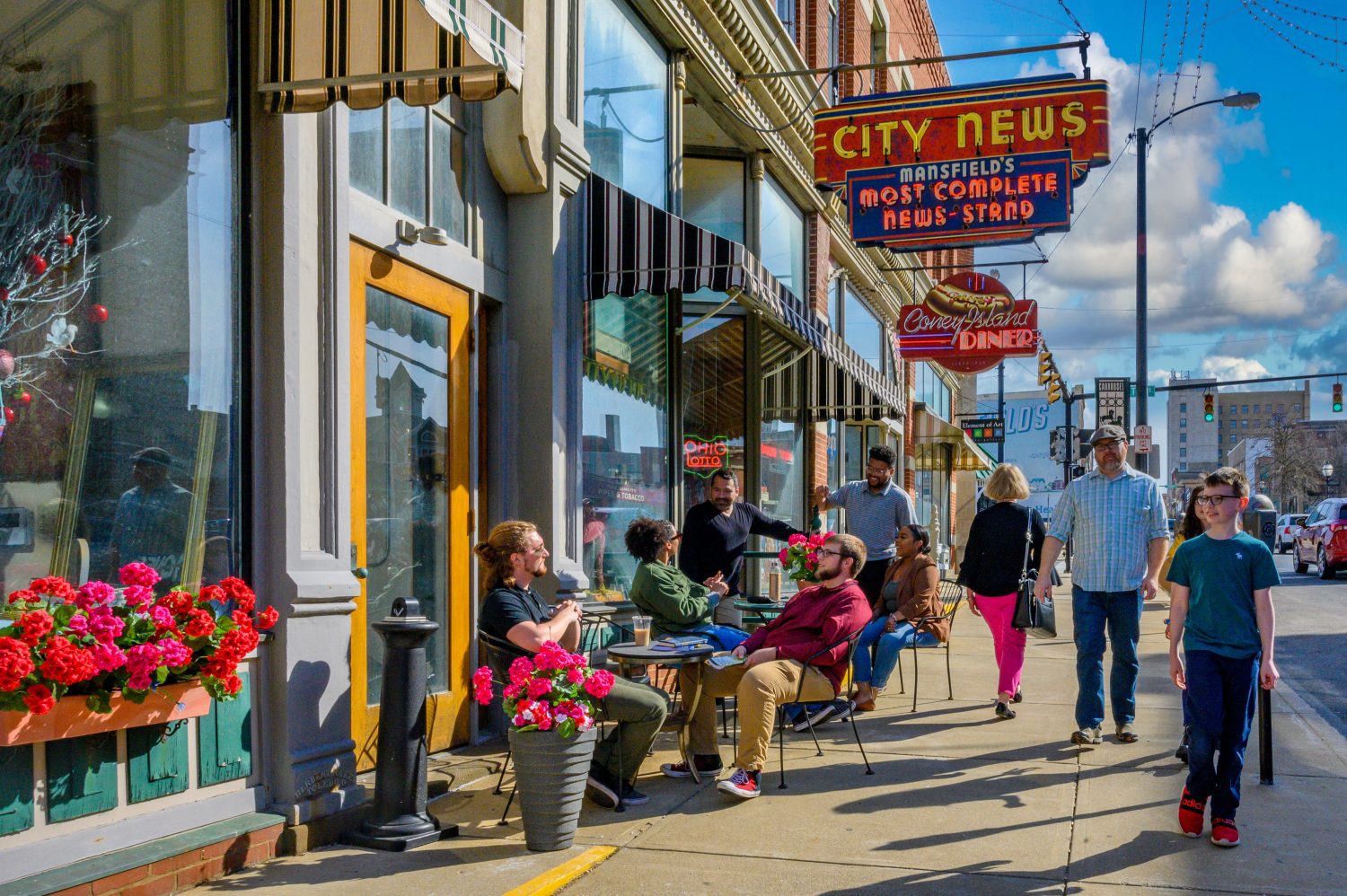
Note: Image courtesy of Destination Mansfield
 nicolederr.com