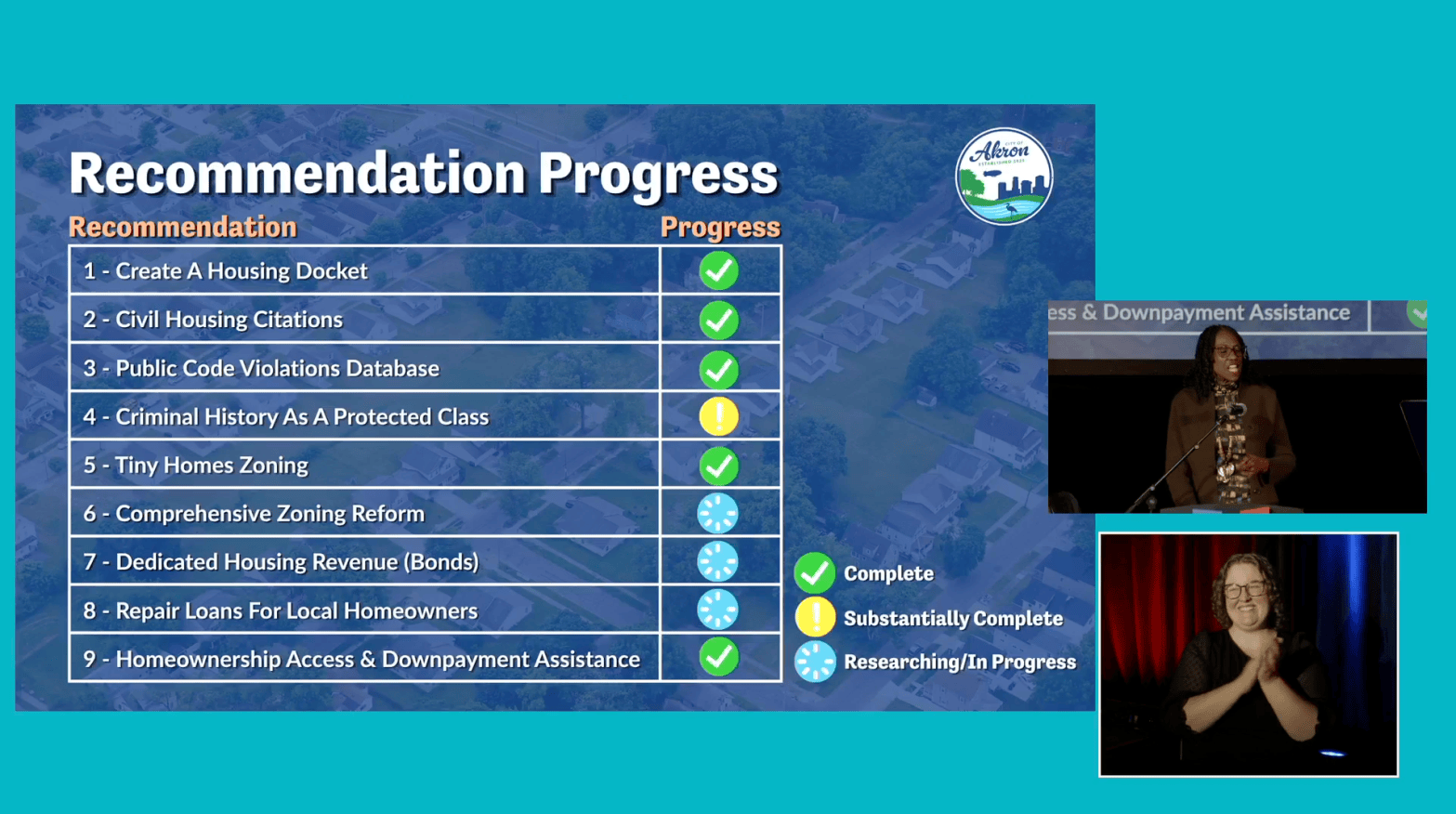
“We believe that everything in this recommendation can become a part of our city” — Shammas Malik, Mayor of the City of Akron, Ohio
I spent some time Thursday and Friday of last week in Akron, Ohio to observe Unify Akron delegates, organizers, and their partners in city government share their progress since their Civic Assembly wrapped.
For those who missed my earlier posts on this topic, the civic assembly in Akron was the first ever in the state of Ohio. A civic assembly is a form of deliberative democracy where a diverse, representative group of everyday residents, led by a skilled facilitation team, discuss, and make recommendations on complex public policy issues. In Akron, 65 residents formed “trusts” of 5, each guided by a facilitator, to consider the issue of safe, affordable housing. Their proposal, dubbed the “Plan of the People” included nine recommendations.
You can read more about my experiences with Unify Akron, and with civic assembly in general here, here, and here.
The events kicked off with a deliberative democracy workshop for elected, civic, and philanthropic leaders from across the state. Attendees learned more about how the civic assembly in Akron was organized, and experienced facilitated deliberation using one of the issues the assembly in Akron actually tackled. In the evening, there was a reception, followed by the city’s response to the proposal, the first of several six month check-ins. On Friday, the knowledge sharing continued with guidance from FIDE North America staff around how best to support civic assembly in our communities, and the findings of their independent review of the Unify Akron assembly.
All in all, it was an exciting and hopeful collection of events with amazing people, all interested in growing the deliberative democracy movement in the United States.
I was impressed with both the thoughtful comments and contributions of my fellow attendees and also the response from the city, which showed real action on all of the issues the delegates proposed. And, once again, I was delighted to see hard working, salt-of-the-earth midwesterners working together to address the very real challenges in their community. It reinforces my faith in the ability of “regular people”, when given the time, space, and information necessary, to solve their own problems in collaborative and community-focused ways.
We’re living in difficult times. We’ve been made to believe that we’re divided on so many topics. And we’ve been conditioned to distrust our neighbors and community members, to keep our guard up, and to respond with quick anger instead of quiet curiosity.
But my experience thus far with deliberative democracy has demonstrated that the angry, divided, and distrusting narrative is a false one. It turns out that we can, with just a little coaxing and intentionality, return to a world where it’s safe to share our experiences and beliefs openly, to respect one another and learn from those around us. From there, it’s not an especially big jump toward working together to design solutions that benefit us all, and proposals that most of us can gladly support.
I want to thank Harry Gotlieb, Morgan Lasher and their teams at Unify America and Unify Akron for exposing me to this model and I want to thank FIDE North America and the newDemocracy Foundation, along with Zakia Elvang and Jacob Birkenhaeger for giving me the opportunity to broaden my knowledge and skills in designing civic assemblies and utilizing deliberative facilitation techniques.
I’m enthusiastically pursuing opportunities to do more work in this space, especially in smaller cities and rural areas in the midwest where I believe the return on the investment will be especially high. In the meantime, though, I intend to implement many of the techniques I’ve learned through these programs in my other, ongoing community and organization facilitation engagements.
You can read more about the City of Akron’s response and watch the recorded event here.

